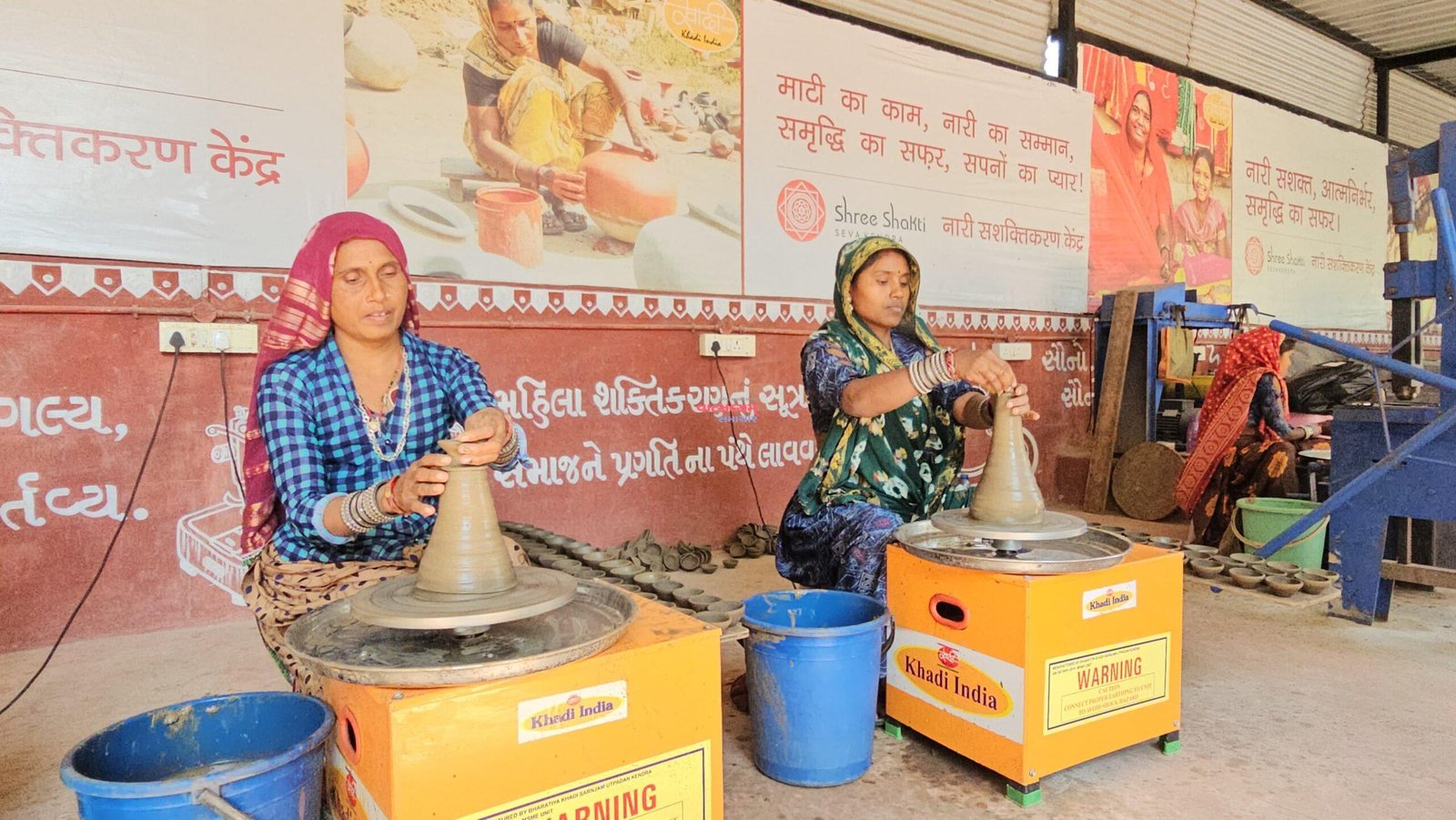
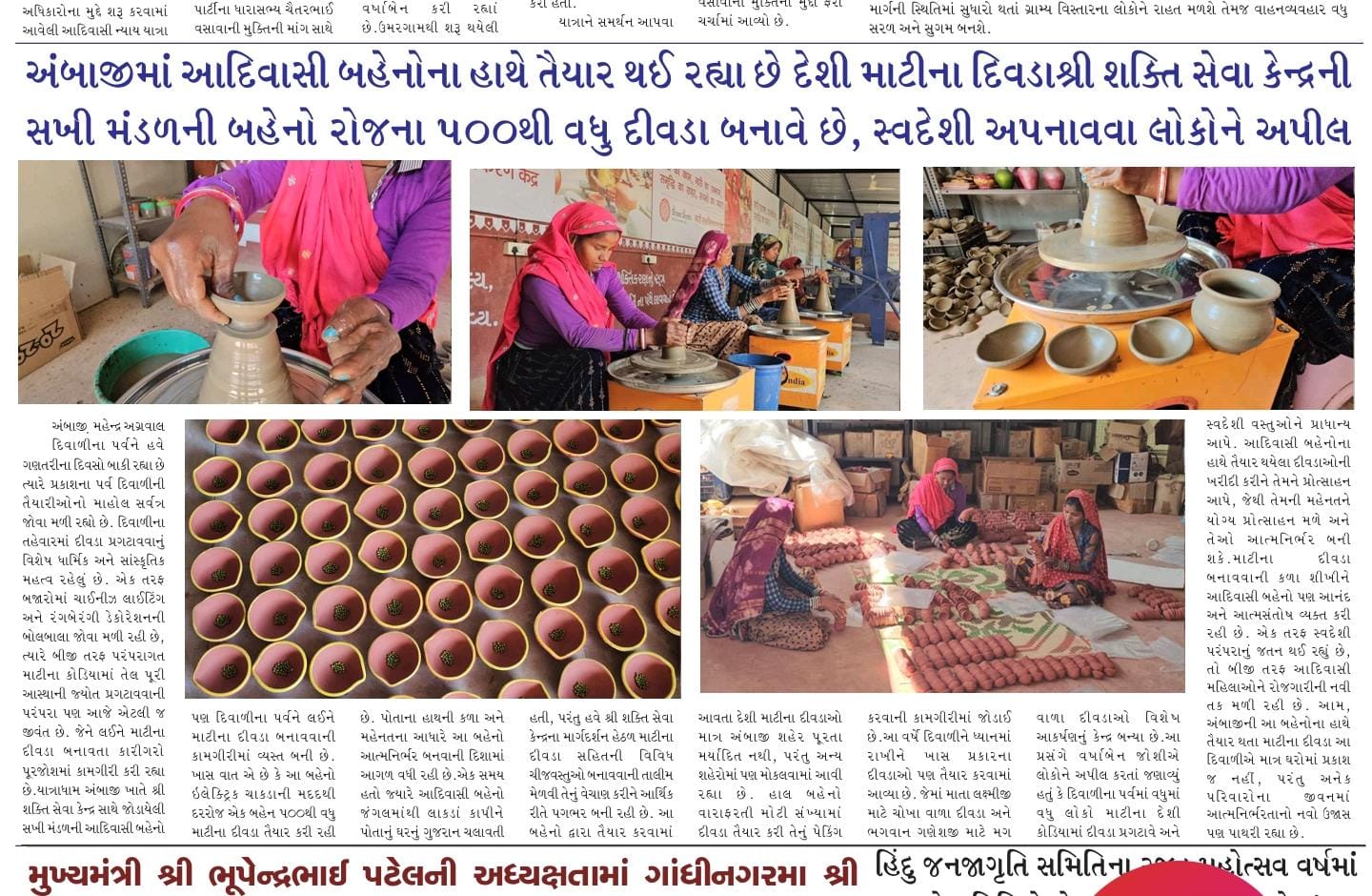
As the sacred pilgrimage town of Ambaji prepares for the festival of lights, a quiet yet profound revolution is taking shape at the pottery wheels of the Shree Shakti Seva Kendra (SSSK). Here, in the foothills of Banaskantha, the tribal women of the Shree Shakti Sakhi Mandal (Self-Help Group) are shaping moist riverbed earth into sacred earthen lamps, producing more than 500 handmade diyas per artisan daily. These are not merely seasonal festival ornaments; they are luminous declarations of financial self-reliance, cultural preservation, and the living embodiment of the national call for Swadeshi.
Where mornings once began with backbreaking treks into the surrounding forests to chop and haul firewood for mere subsistence, these resilient tribal women now operate modern electric potter’s wheels (chakdas), run organized packaging lines, and manage ledger books. Supported through SSSK’s comprehensive women empowerment and skill training initiatives, their handcrafted terracotta lamps are traveling far beyond local village markets to homes across Ahmedabad and major cities of Gujarat. Learn more about the craft collections on the SSSK livelihood projects showcase.
From Forest Firewood to Electric Pottery Wheels: A Journey of Self-Reliance (Aatmanirbharta)
For generations, the indigenous tribal women of Ambaji and rural Banaskantha faced severe economic precarity. With few dignified livelihood opportunities, many families depended on gathering firewood from dense jungle tracts—a hazardous, exhausting, and ecologically depleting activity that yielded barely enough to buy evening rations. Children frequently accompanied their mothers into the forests, sacrificing school hours to help carry timber.
Shree Shakti Seva Kendra intervened to break this cycle of generational poverty by introducing structured vocational training. Recognizing the ancient heritage of Indian terracotta craftsmanship, SSSK equipped local women with state-of-the-art electric pottery wheels, organized them into cooperative Sakhi Mandals, and provided comprehensive training in clay selection, precision centering, high-speed molding, kiln firing, and protective packaging. Today, the firewood axe has been permanently replaced by the artisan wheel. As reported on the ground by journalists Jitesh Joshi and Mahendra Agarwal in Vatsalyam Samachar, these women have transformed into self-respecting micro-entrepreneurs who earn consistent seasonal income, operate their own bank accounts, and lead household financial decisions.
Precision, Speed, and Devotion: How Each Artisan Molds 500+ Diyas Every Day
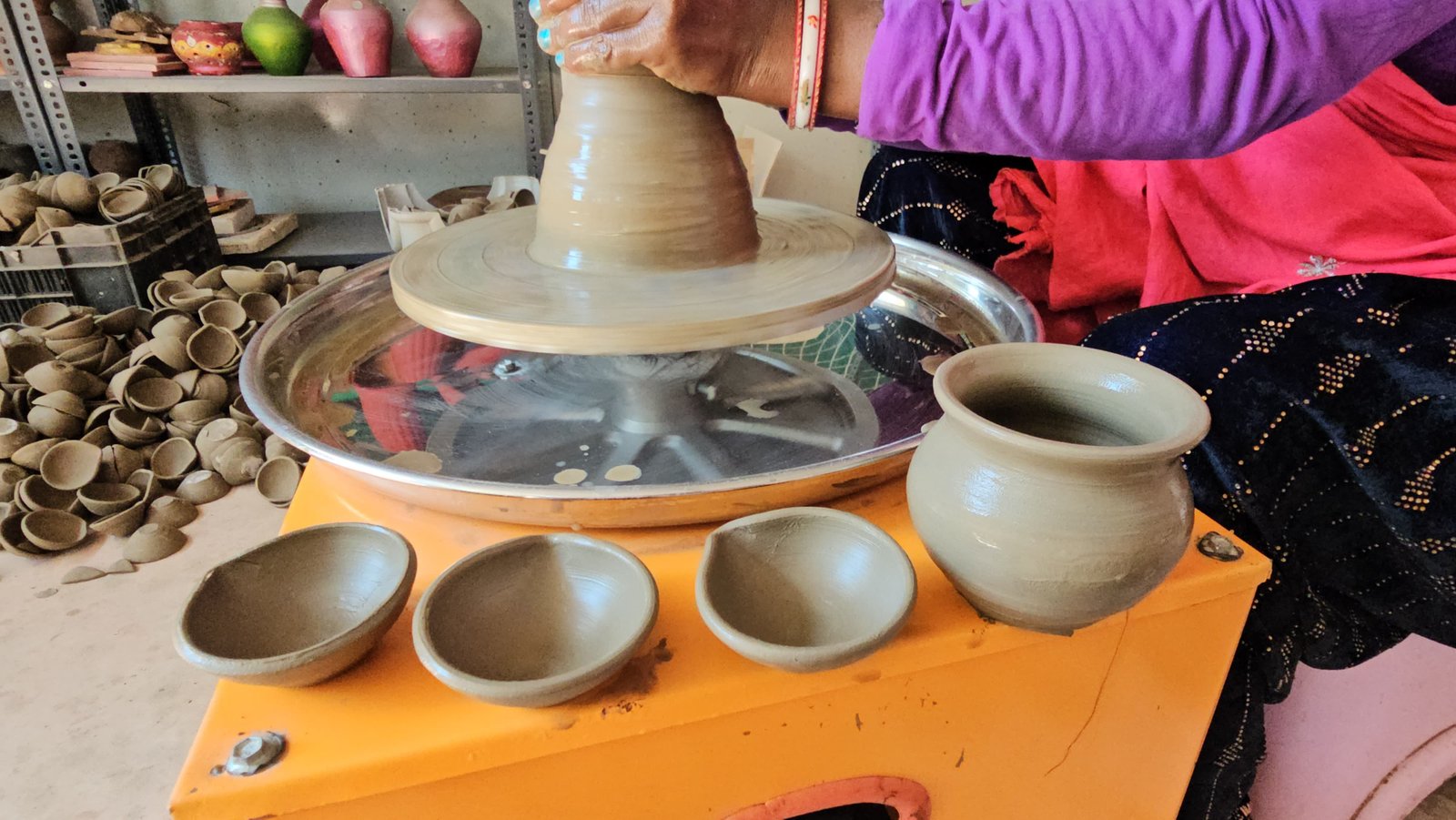
Molding 500 earthen lamps in a single day requires immense discipline, muscle memory, and focus. The transition from erratic hand-spinning stones to speed-controlled electric wheels has multiplied artisan productivity fivefold without compromising artisanal uniqueness. Each lamp is a masterclass in ergonomics and indigenous engineering:
The process begins with locally sourced, thoroughly sieved natural clay, purified of gravel and kneaded to optimal elasticity. Seated at their spinning electric chakdas, the artisans shape each kodiya with deft finger pressure—establishing a stable, flat base, uniform wall thickness that prevents oil seepage, and a precisely pinched wick-spout designed to hold cotton battis securely in place. Once shaped, the diyas undergo gradual shade-drying to prevent warping, followed by controlled sun-baking and high-temperature kiln firing that lends them their resonant ring and rich terracotta hue.
Sacred Innovations for Diwali: Lakshmi Rice Diyas and Ganesha Moong Diyas
While mass-manufactured markets are inundated with synthetic glitz, the SSSK Sakhi Mandal has introduced distinctive, spiritually rooted designs that revive authentic Vedic festival traditions. Alongside classic earthen kodiyas, two specialty offerings have become the center of celebration this festive season:
1. Maa Lakshmi Akshat (Rice) Diyas — Embodying Wealth and Abundance
Crafted specifically for Diwali Pujan, these sacred diyas incorporate unbroken rice grains (Akshat) into their design. In Hindu scriptures, unbroken rice is the foremost offering to Goddess Lakshmi, symbolizing purity, unbroken continuity of fortune, and agricultural sustenance. Lighting oil in an Akshat-adorned terracotta diya honors the presence of Mahalakshmi in the home while grounding prayer in the earth that nourishes us.
2. Bhagwan Ganesha Moong Diyas — Invoking Auspiciousness and Overcoming Obstacles
Dedicated to Vighnaharta Ganesha, these festive lamps feature sacred green gram (Moong) motifs. In traditional rituals, moong signifies wisdom, intellect, and the removal of hurdles. Lighting a Ganesha Moong Diya at the home entrance or puja altar marks an auspicious threshold, inviting clarity and peace into family life for the New Year.
3. Traditional Terracotta Kodiyas — The Five Sacred Elements (Panchatatva)
Unlike non-porous plastic or metal holders, natural clay represents the sacred union of the Panchatatva: Bhumi (earth), Jal (water for kneading), Vayu (air for drying), Agni (fire for baking), and Akash (ether through which the flame radiates). Porous terracotta allows pure sesame or mustard oil to breathe, ensuring a steady, golden, and smoke-free flame that purifies the festive atmosphere.
4. Eco-Conscious Packaging for City-Wide Dispatch
Recognizing that artisanal goods often suffer transport breakage, the sisters have been trained in shock-absorbent, sustainable packaging using straw, corrugated cartons, and eco-friendly sleeves. Working in shifts, the women batch, count, inspect, and package thousands of diyas daily, fulfilling dispatches to temples, residential societies, corporate gift drives, and retail stalls across Palanpur, Mehsana, Gandhinagar, and Ahmedabad.
The Swadeshi Appeal: Choosing Dignity and Heritage Over Chinese Plastic
Speaking on behalf of the initiative, Varshaben Joshi of Shree Shakti Seva Kendra made an earnest appeal to conscious citizens and festive shoppers: to embrace Swadeshi in letter and spirit by bringing home handmade clay diyas instead of cheap, disposable Chinese electronic lighting and plastic trinkets.
“When a family buys a box of machine-made plastic LED lights, their money flows to distant foreign factories,” Varshaben Joshi noted. “But when you light a traditional earthen kodiya crafted by our tribal sisters in Ambaji, your festive spending directly provides dignified wages, funds children’s school supplies, and honors India’s age-old artisanal heritage. True Diwali is when the light on your porch brings prosperity to a rural craftsman’s hearth.”
Embracing Swadeshi is not merely an economic decision—it is a spiritual choice. Burning oil in an earthen lamp generates negative ions that purify the surrounding air, while synthetic fairy lights end up in municipal landfills as toxic electronic waste. Choosing clay is a vote for zero-waste ecology, ethical consumerism, and local self-sufficiency (Vocal for Local).
The Ripple Effect: How Festive Diyas Keep Tribal Children in Classrooms
At Shree Shakti Seva Kendra, livelihood programs do not operate in isolation—they are systematically integrated with the organization’s flagship mission: ભિક્ષા નહીં શિક્ષા (Education, Not Begging). Economic stability for mothers directly translates into educational retention for children.
In previous years, economic strain forced tribal families to send adolescent boys and girls to labor in marble quarries or beg near pilgrimage corridors. With predictable income from the Sakhi Mandal’s pottery and handicraft production, artisan mothers can independently afford school uniforms, notebooks, and travel expenses. Their children study at SSSK’s free primary education centers and receive balanced nutrition at the SSSK residential hostel facility in Ambaji.
Every rupee earned through these 500+ daily lamps strengthens an unbroken circle of social impact. Learn how this community model earned formal governmental commendation in the TDO Recognition and impact review.
Conclusion: This Festive Season, Light a Lamp That Illuminates Two Homes
The festive earthen diyas of Ambaji demonstrate that empowerment is built with patience, skill, and genuine community support. When an artisan sister centers a ball of clay on her spinning wheel, she shapes more than a lamp—she shapes her family’s destiny, stepping firmly from dependence to independence.
This festival season, let your prayers resonate with meaning. Replace transient plastic with sacred terracotta, celebrate the timeless beauty of Swadeshi craftsmanship, and illuminate two homes at once: your own sanctuary and the household of a hardworking tribal artisan sister. To place bulk orders, partner for institutional Diwali gifts, or support upcoming training workshops, visit the livelihood projects portal or contribute directly through SSSK’s online donation portal.
Frequently Asked Questions
1. How many lamps do the Sakhi Mandal artisans make each day?
▲
2. What are the special festive designs created for Diwali?
▲
3. How does this project help tribal women achieve financial independence?
▲
4. Why does SSSK appeal to people to adopt Swadeshi earthen lamps over imported plastic lights?
▲
5. Where can individuals and corporate buyers purchase these handmade diyas?
▲
ભિક્ષા નહીં શિક્ષા | Education, Not Begging
Support Tribal Women Artisans & Bring Home Swadeshi Light
Warming Lives with Dignity: Usha Maa Leads Special Blanket Distribution at Shree Shakti Seva Kendra
As chilly winter breezes sweep across the rugged Aravalli foothills surrounding Ambaji, warmth of a deeply spiritual and...
Read More →From Ambaji to National Stage: The Inspiring Journey of the Bagpiper Band | SSSK
A decade ago, the idea sounded audacious in Ambaji’s tribal lanes — a bagpiper band of first-generation learners in cris...
Read More →15 Years of SSSK: A Timeline of Milestones, Challenges, and Triumphs | SSSK
Fifteen years can be counted in calendars — or in lives changed. From a small intervention in 2011 to a comprehensive mo...
Read More →How SSSK’s Awareness Campaigns Are Changing Mindsets About Child Begging | SSSK
Changing a mindset is harder than handing a coin — and far more lasting. In Ambaji’s temple lanes and Banaskantha settle...
Read More →